
Asana-Salesforce Integration: Methods, What to Sync, and How To Set It up in 2026
Asana and Salesforce are two examples of tools uniquely suited to their own purposes. Asana is one of the most popular project management platforms on the market, while Salesforce is the de facto platform for thousands of sales and customer success teams. But these tools rarely work well together out of the box. Without an effective way to close the gap between these tools, teams can struggle and workflows can falter.
In this guide, you’ll learn about integrating Asana and Salesforce, including what options are available, what you can sync, and common use cases.
Market overview: Asana-Salesforce integration
| Built in Salesforce + Asana integration | One-way automation (e.g., Zapier) | Two-way sync (e.g., Unito) | |
| Sync Direction | One-way, from Salesforce to Asana. | One-way, trigger-based automation. | Two-way. |
| Real-time or batch | Near-real-time. | Real-time. | Real-time. |
| Field mapping depth | Standard fields, custom fields. Attachments aren’t supported. | Standard fields; custom fields and attachments usually not supported. | Standard fields, custom fields, comments, attachments, hierarchy mapping. |
| Setup time/effort | Low. No-code setup. | Low. No-code with limited configuration. | Low. No-code setup. |
| Best for | Rules-based hand-offs triggered by changes in Salesforce. | Simple visibility and handoffs. | Seamless collaboration across teams. |
Why integrate Asana and Salesforce
Integrating Asana and Salesforce typically means closing the gap between customer-facing teams and project managers. That might be for planning marketing campaigns based on information collected from existing customers, planning post-sales delivery after a deal closes, or surfacing customer success trends in your project management tool. Collaborating across these tools typically involves manually copying data back and forth, having multiple alignment meetings each week, and having the occasional update fall through the cracks. When you integrate these two tools, you’ll get the following benefits:
- Fewer licenses: When workflows need to cross the gap between Asana and Salesforce, at least a few people will need licenses in both tools, whether it’s to get visibility on the work happening in them or to actually transfer data back and forth. With integrations, you can eliminate many of these excess licenses.
- Seamless collaboration: The workarounds you need to work between Asana and Salesforce create friction for just about every task. With an integration, each team can work from their own tool while knowing they have full access to the data in the other. It’s the closest you can get to working from a single tool without actually forcing anyone into it.
- Smoother workflows: The more your workflow has to move across tools, the more opportunities it has to stop and stall. With an integration, you can remove these obstacles and keep workflows moving smoothly.
- Better reporting and visibility: Reporting on cross-functional work usually involves a mess of data exports, manual data entry, and outdated information. Integrating Asana and Salesforce means you can use either tool’s reporting features (or both) to get better visibility on the work happening in them.
- Real-time updates: Some integrations update data between Asana and Salesforce in real time. That means no batch updates and no wondering if you’re working with outdated data.
Integration depth between Asana and Salesforce
There’s a number of ways you can integrate Asana and Salesforce, and they aren’t all created equal. One of the biggest differences between them is integration depth, or the amount and type of data they can sync. Here’s what to look for.
Work item previews
The shallowest level of integration only shows a preview of work items in one tool in matching items in another. That means, for example, representing a Salesforce opportunity as a panel in an Asana task, listing who’s taking care of it, the company it’s linked to, and its potential value. Collaborators in Asana can’t interact with Salesforce data at all, but sometimes they’ll get a link they can click through to open the original opportunity. This integration depth is a solid choice for workflows where you just need visibility into a secondary tool but it doesn’t really support collaboration across tools.
Standard fields in Asana and Salesforce
Integrations that go beyond work item previews usually support most, if not all standard fields in Salesforce and Asana. “Standard” fields are built right into the tools without requiring any customization, like assignee, due date, and comments. Integrations can usually map similar fields automatically while others, like statuses and priority, need some transformation or manual mapping.
Custom fields in Asana and Salesforce
Custom fields are any fields that you can add to Asana and Salesforce workspaces. Asana’s custom fields, for example, include single-select, multi-select, text, number, dates, and more. Salesforce custom fields include address, checkbox, currency, date, email, lookup relationship, and picklist.
Not all integrations can support custom fields, since they usually require more transformation than standard fields. Some platforms only handle a few fields, while others support most of them.
Comments and notes
Comments are often as important for your workflows as any other information in your work items. A project manager’s tasks might have a few comments describing essential context that a salesperson needs to understand why a certain deal fell through. A Salesforce case might have notes that can inform a future marketing campaign.
Attachments between Asana and Salesforce
Attachments allow teams to share deliverables, briefs, and context between tools. Not all integrations can sync them and those that do handle them differently.
Unito, for example, can support attachments in one of three ways: linked, copied, and streamed attachments.
- Linked attachments create a hyperlink in synced work items. When you click on the link, it opens the original attachment in the tool it came from.
- Copied attachments make the same attachment visible in multiple tools.
- Streamed attachments create a unique page for each attachment, independent of either tool.
Hierarchies: Asana subtasks, projects and portfolios
Tools like Asana often have hierarchies, which are relationships between different types of work items. Asana, for example, has tasks, subtasks, projects, and portfolios. Integrations that don’t support hierarchies treat all work items like they’re the same, which makes it difficult to keep track of your work.
The 3 most common methods for setting up an Asana-Salesforce integration
Asana’s built-in Salesforce integration
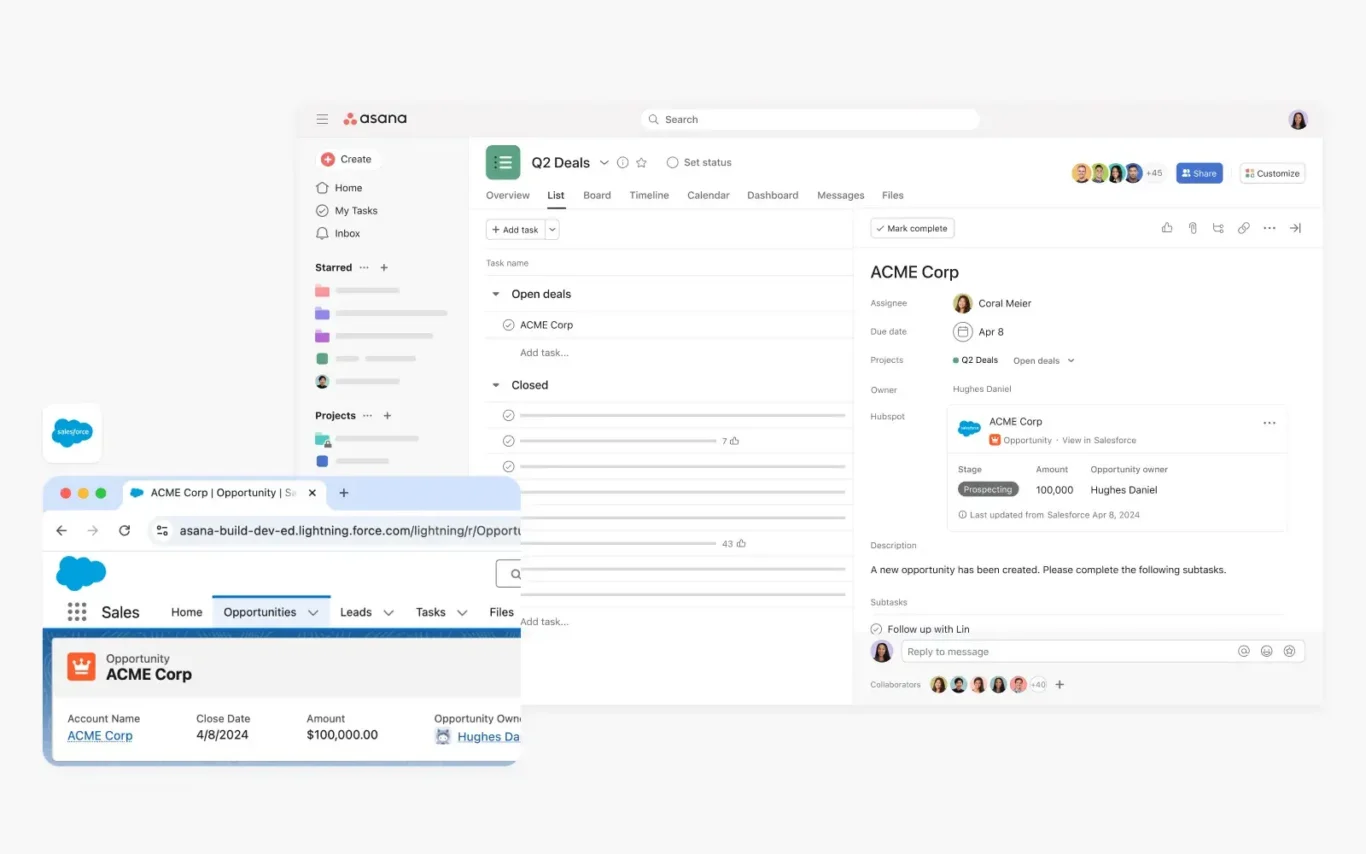
Asana’s built-in Salesforce integration allows you to build Asana rules that automate actions in Asana based on changes in Salesforce. These rules use one of two Salesforce triggers:
- Record is created, which kickstarts an action when a Salesforce record that meets predetermined criteria is opened.
- Record is created or updated, which could include anything from creating Asana tasks when Salesforce opportunities reach a specific deal stage or when an opportunity with a certain currency is created.
The rules you build with this integration can also keep Salesforce records and Asana tasks in sync, though they’ll only move data in one direction, from Salesforce to Asana. It’s available on Asana’s Advanced, Enterprise and Enterprise+ tiers. Asana’s older AppExchange package, the Asana in Salesforce app, was deprecated on February 27, 2026, so these rules are now the only built-in option.
Best for: Handoffs triggered by actions in Salesforce that don’t require a two-way sync. For a closer look, see the Asana in Salesforce app vs. Unito.
One-way automation (e.g., Zapier)
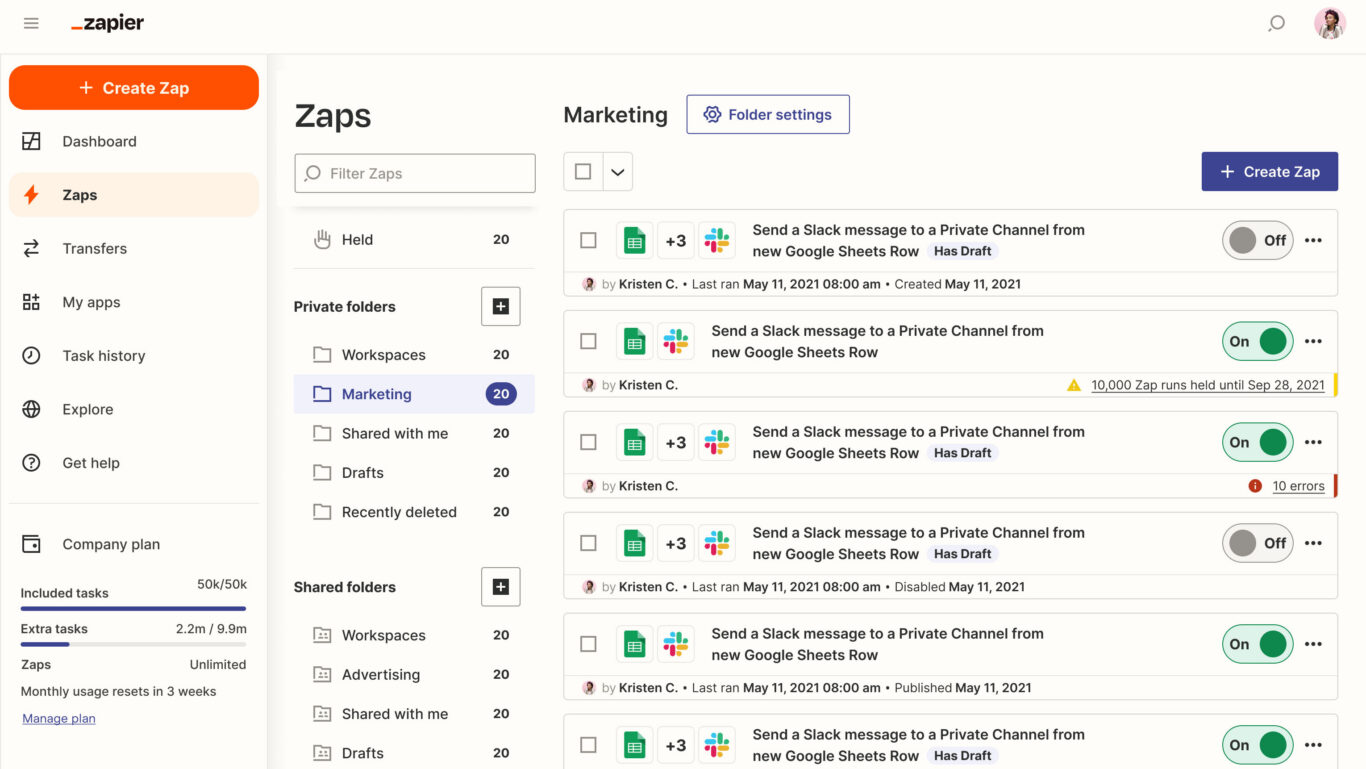
Third-party automation tools like Zapier use trigger-action logic to automate actions across Asana, Salesforce, and hundreds of other tools. These actions include automatically creating work items in Salesforce to match Asana tasks or updating a specific field in Salesforce when a similar field is changed manually in Asana.
These automation platforms are well-suited to linear workflows, like approvals and simple handoffs. They cover so many tools and fields that it’s hard to find tool pairings they can’t support. But the automations you build with these platforms typically only cover a single action. An automation can either create a work item or update a single field; it can’t do both. That means you can’t cover every step in a workflow without creating (and managing) multiple automations.
Best for: Automating high-volume work item creation between Asana and Salesforce with minimal need for visibility or collaboration.
Two-way sync (e.g., Unito)
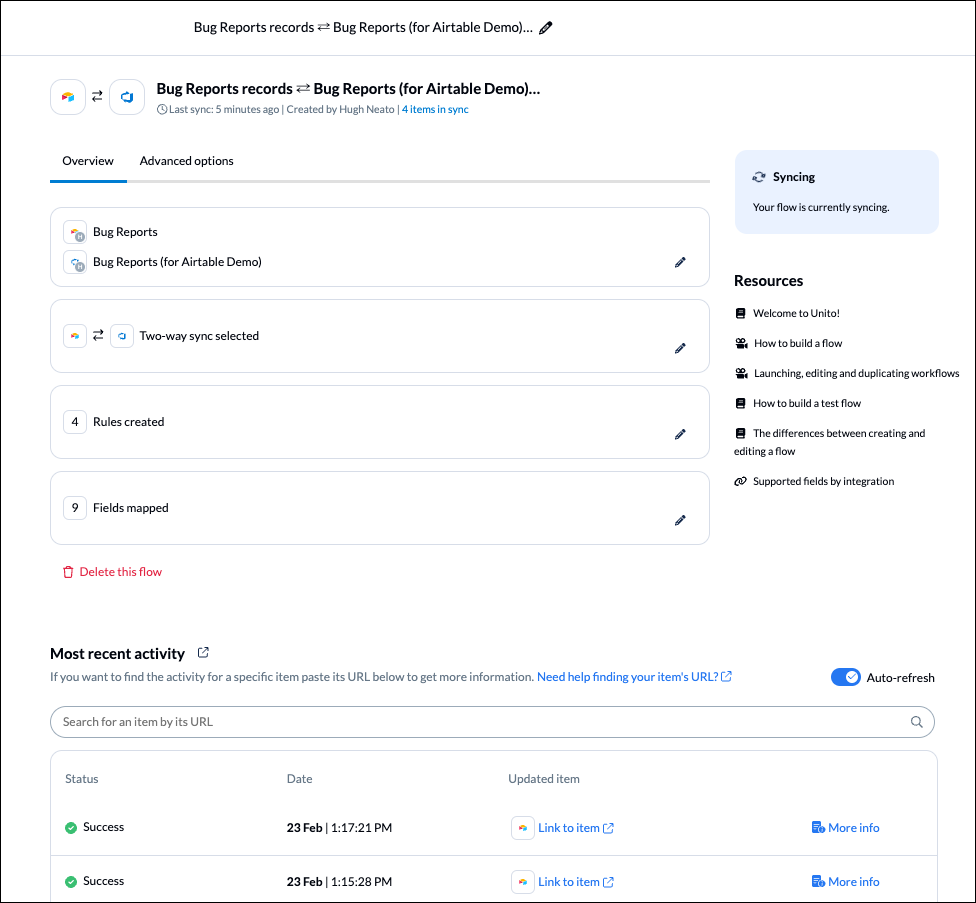
A two-way (or bidirectional) sync platform like Unito creates relationships between Asana tasks and Salesforce work items, keeping everything up to date as you work. Items are automatically created to match the ones you create manually, and fields are continuously updated in both tools.
Two-way sync platforms typically offer deep integrations that cover most, if not all, standard and custom fields, attachments, comments, and more. Some platforms can even sync hierarchies between tools. These deep integrations can handle all kinds of workflows, from simple approvals to handoffs and true cross-functional collaboration.
Best for: Working seamlessly across Asana and Salesforce with full visibility and no doubling up on tool licenses.
How to choose an Asana-Salesforce integration
When choosing between integration options for Asana and Salesforce, these are the criteria you should evaluate.
One-way or two-way
A one-way integration pushes data from Asana to Salesforce or Salesforce to Asana, not back-and-forth. A bidirectional sync can both move data back-and-forth or in one direction. If your workflow needs true, seamless collaboration, you’ll usually want to go for a two-way sync. But if you’re managing handoffs and linear workflows, then a one-way integration might be enough.
Custom field and custom object support
If your workflows depend heavily on custom fields and custom objects, then you need an integration solution that can support them. When choosing an integration solution, investigate how many custom fields they support and whether they support custom objects or not.
Real-time or scheduled updates
Real-time updates allow your teams to have the most-up-to-date information whenever they’re working, but that’s not a necessity for every workflow. If your workflow doesn’t need real-time updates, you’ll have a wider choice of integration solutions.
API limits in Asana and Salesforce
An API (Application Programming Interface) is what allows integrations to pull data from one tool, translate it, and supply it to another tool in a way that it can understand. But some tools have API limits, which restrict the number of times a tool can ping that API for updates. Sometimes these limits only affect massive amounts of data, while other limits are much more restrictive. It’s worth researching these limits and how a potential integration tool handles them.
Who can set it up
Some integration platforms are best set up by IT, software engineers, and similar roles, while others can be deployed by any business user. One approach isn’t necessarily better than the other overall, but it might be better suited to your organization. Some teams want tighter control around who can build integrations while others want broader access.
How each integration handles errors
Integrations can run into errors that prevent data from syncing entirely, create duplicates, or even accidentally delete data. How much damage these errors can do depends on how each platform handles them. Some stop trying to sync entirely while others keep trying until the error resolves itself. Yet other integrations have built-in methods for avoiding many of these errors entirely.
Security and data residency
Data security is essential when integrations have access to sensitive, proprietary information. Research a platform’s security certifications and compliance record, whether it’s for generic standards like SOC 2 or specific standards, such as CCPA or HIPAA.
Data residency refers to where data is stored, and some organizations may have to meet certain data residency requirements when choosing an integration vendor.
Pricing model of each integration option
Choosing a pricing model that matches your needs avoids ballooning monthly costs and licenses. Some examples of pricing models include:
- Per-task, where a platform charges for every task it creates or updates.
- Per-connector, where a platform charges for every integration you use.
- Per-user, where you’re charged for every user with access to the integration platform.
- Per-item-in-sync, where you’re charged for every work item an integration keeps in sync.
Use cases for an Asana-Salesforce integration
Post-sales delivery
Your sales team works relentlessly to close deals in Salesforce. That work creates a ton of context and comments before the deal closes and is passed on to whoever delivers the actual product or service that’s been sold. An Asana-Salesforce integration automatically sends all that context over to Asana as soon as a Salesforce opportunity is marked as “won,” meaning the post-sales team has everything they need to hit the ground running.
AI context for Asana and Salesforce agents
Both Asana and Salesforce have built-in AI agents, but these agents usually only have access to the context in one tool. Additional context from other tools ensures AI agents have more information when performing tasks, can answer questions more accurately, and can flag issues they’d miss without that additional context.
Pipeline visibility for delivery teams
There are teams beyond sales that need visibility into your pipeline. Post-sales delivery teams, support teams, finance, and legal all might need to check in on your pipeline, but giving them Salesforce seats might be prohibitively expensive. An integration can send signals from Salesforce to Asana for better visibility.
Campaign-to-pipeline attribution
Marketers that work in Asana often lack the data that can confirm the success of their marketing campaigns. By integrating Salesforce with Asana, marketers can get eyes on won opportunities in Salesforce that are tied to their campaigns, through custom fields that surface attribution.
Customer context continuity
Say your CS teams use Asana to manage their ticket flow. That means they don’t have access to anything that happens before a prospect becomes a customer, since all that context is in Salesforce. An Asana-Salesforce integration puts all that context at everyone’s fingertips, reducing the amount of back-and-forth communication required for teams to stay in sync.
Pipeline health reporting
Salesforce has strong, built-in reporting features, but if relevant stakeholders prefer using Asana, there’s no point using Salesforce reports. An integration can put all the data you need from Salesforce in Asana projects, allowing you to use Asana’s own reports, right where your stakeholders need them.
Resourcing and capacity planning
Are team leads in Asana guessing at what’s happening in Salesforce? Poor visibility on work load and resourcing means salespeople and customer success agents are either saddled with more work than they can handle or too little, threatening your pipeline or SLAs. With the right integration, you can get a better view on capacity in Salesforce from Asana, allowing you to dispatch work more efficiently.
Asana-Salesforce integration best practices
No matter which integration you pick, consider the following best practices.
- Start with a small pilot project between a few tasks in Asana and work items in Salesforce. This allows you to test integrations and adjust them before you deploy them more broadly.
- Evaluate the results of a pilot project before implementing integrations at scale. Look for places where integrations save your teams time as well as situations where they might not be as effective as you expected.
- Consider whether your chosen integration platform is accessible enough for business users or whether you need to restrict it further to technical teams.
- Regularly review the integrations you use, at least yearly. Compare capability, price, and connector availability with other vendors.
- Use built-in integrations where possible, at least initially, and enhance them with third-party integrations as your needs start to evolve.
What breaks and how to fix it
Comment sync loops
This usually isn’t a sync loop — it’s attribution. By default, Unito posts synced comments and updates under the account of whoever set up the flow, so every comment can end up looking like it came from one person, even when five different reps and developers wrote them. The fix is a dedicated service or bot account for the flow, so synced activity carries a distinct identity instead of one teammate’s name showing up everywhere. If you’re seeing genuine duplicate comments (not just misattributed ones), check for more than one flow watching the same Asana project and Salesforce object — that’s the actual cause when it happens.
Assignees or owners aren’t syncing
This is almost always a mapping or permissions issue, not a compatibility one. Check that Assignee and Owner are explicitly paired in your field mappings. On the Asana side, only users who are assignable on the project show up as valid sync targets — a Salesforce opportunity owner with no matching, assignable Asana account simply won’t sync until that’s fixed.
Asana’s sections and Salesforce’s deal stages don’t line up
Asana sections rarely map cleanly onto a Salesforce opportunity’s deal stages. Unito handles this with status mapping: pair values individually for a strict 1:1 relationship, or group several source statuses into one target value. Grouping has a quirk worth knowing before you configure it — Unito always syncs the first status in a grouped set, so a task moving between two grouped statuses can look stuck on the Salesforce side. If every status change needs to reflect accurately, map values individually instead of in groups.
Picklist fields reject synced values
Salesforce picklists only accept predefined values, while a lot of Asana fields are free text or use differently-worded options. Unito automatically matches similar option names, but anything that doesn’t line up needs a manual value pairing — and a Salesforce picklist will silently reject any incoming value it doesn’t recognize as valid. Before launching a flow, walk through every possible Asana value for a mapped field and confirm each one has a matching Salesforce option.
Attachments don’t come through
Salesforce and Asana cap attachment sizes differently, and the smaller limit always wins. Salesforce’s standard Attachment object tops out at 25MB per file (Salesforce Files, a separate object, allows up to 2GB). Asana defaults to 100MB per file. A large file attached in Asana can fail to sync over if it breaches Salesforce’s 25MB ceiling, which teams should be aware of.
Deleting a record on one side doesn’t delete it on the other
This is usually by design, rather than a bug. Integrations rarely delete an item, comment, or field value on one side just because it was deleted on the other, and won’t recreate a deleted item on a future sync — the assumption is that a deletion was intentional. To fully remove a record from both systems, delete it manually on both ends. Re-launching a flow after this won’t restore anything; it will only re-link items that still exist on both sides.
A large first sync stalls partway through
This shows up when integrations are pulling and writing thousands of records during an initial sync and runs into Salesforce’s API ceiling. IF a flow does hit this, integrations will pause and surface a rate-limit error rather than fail silently. Narrowing the initial sync with rules — so you’re not backfilling years of closed cases on day one — is the most common fix, alongside increasing Salesforce’s API allocation if the org’s plan supports it.
Setting up a two-way sync with Unito
- Connect tool accounts to Unito: After signing up for Unito, click +Create Flow and connect Asana and Salesforce.
- Choose flow direction: Flow direction tells your Unito flow where you need new work items created. Most Unito flows are two-way, meaning they automatically create work items in both connected tools.
- Set rules: Unito rules use trigger-action logic to filter out work items you don’t want synced or automate certain actions. To build a rule, choose a trigger Unito should look for and the action it needs to take.
- Map fields: In most flows, Unito can automatically map fields in Asana with fields in Salesforce. From there, you can customize field mappings to match statuses across tools, send data from some fields to fields specific to your workflow, and more.
- Launch your flow: Once you map your fields, your flow is ready to launch. After an initial sync, Unito will check for changes in real-time.
Ready to start?
Meet with a Unito product expert to see how two-way integrations can transform the way you work.
What you can sync between Asana and Salesforce
| Asana task field | Salesforce opportunity equivalent | Sync direction |
| Assignee | Owner | Two-way |
| Attachment | Attachment | Two-way |
| Comment | Comments | Not supported by Unito |
| Completion Date | Close Date | Two-way |
| Created At | Created Date | One-way |
| Created By | Created By | One-way |
| Date* | Date* | Two-way |
| Description | Description | Two-way |
| Due Date | Close Date | Two-way |
| Globally Unique Task Identifier | Record ID | One-way |
| Link to Task | URL* | One-way |
| Multi-Select* | Multi-Select* | Not supported by Unito |
| Number* | Number* | Two-way |
| People* | Lookup field* | Two-way |
| Project Name | Text* | One-way |
| Section / Column | Stage | Two-way |
| Single-Select* | Picklist* | Two-way |
| Start Date | Date* | Two-way |
| Status | Stage | Two-way |
| Subtask | No equivalent | N/A |
| Tag | Tag | Two-way |
| Task Name | Account | Two-way |
| Task Type | No equivalent | N/A |
| Text | Text* | Two-way |
| Updated At | LastModifiedDate | One-way |
*custom field
Frequently asked questions: Asana-Salesforce integration
What Salesforce objects can I sync with Asana?
Unito’s Salesforce connector can sync opportunities, tasks, contacts, leads, and cases with tasks, projects, and portfolios through the Asana connector. Each Unito flow syncs one type of object for each tool.
Is Unito a one-way or two-way integration?
Unito provides true two-way synchronization between Asana and Salesforce, meaning changes made in either tool are automatically carried over to the other. You can also build one-way flows, which are a better fit for some workflows.
How long does it take to set up this integration?
Unito integrations don’t take any technical skill or developer time to deploy, and most Unito users start syncing work items within a few minutes. You’ll start seeing value within days.
How quickly do changes sync between Asana and Salesforce?
Unito syncs changes between tools in real-time, allowing teams to collaborate seamlessly across Asana and Salesforce.
What are the benefits of Unito’s 2-way Asana Salesforce integration?
A two-way sync between Asana and Salesforce lets sales and delivery teams each work in their own tool while seeing the same records, so fewer people need a license in both. Because Unito updates both tools in real time, reports in Asana and Salesforce draw on the same data.
What is the best way to integrate Asana and Salesforce?
When integrating Asana and Salesforce, you have a few options:
- Automation platforms like Zapier, which can automate simple actions like creating new work items and updating a single field.
- Built-in integrations, which both Asana and Salesforce offer. These integrations are the easiest to deploy, but have more limited functionality.
- Two-way sync platforms like Unito, which builds two-way relationships between work items, keeping them up to date in real time.
To know which method works best for you, ask yourself what your workflow needs. Automation platforms are best used for simple workflows, while built-in integrations are often best suited for teams with little experience integrating their tools. Two-way sync platforms are a great fit for workflows that involve close, constant collaboration between teams.
What workflows does Unito’s Asana-Salesforce integration support?
Unito’s Asana-Salesforce integration can support a number of workflows, including:
- Ticket escalation
- Software development
- Project management
- AI agent integration
- Time tracking and billing
- Record syncing
Can Unito create Asana projects from Salesforce records?
Unito can’t automatically create new Asana projects, but it can automatically create tasks in your projects, located within sections/columns.
Can Unito manage task allocation between sales and post-sales teams?
Yes, the integration can automate task hand-offs between Sales and Post-Sales teams, streamlining the process and reducing manual work.
That said, customization is a cornerstone of efficiency. With an Asana custom template, you can tailor project outlines to fit your sales processes within Salesforce perfectly.
How does Unito improve sales cycle visibility?
This integration between Asana and Salesforce helps everyone involved follow progress on tasks and projects to better manage the sales cycle. With consistent data sharing, you can keep Asana updated based on Salesforce (or vice versa) in real-time, enabling informed decisions at every turn.
And if you ever need an immediate update, a manual sync option is at your fingertips, ensuring updated records.