
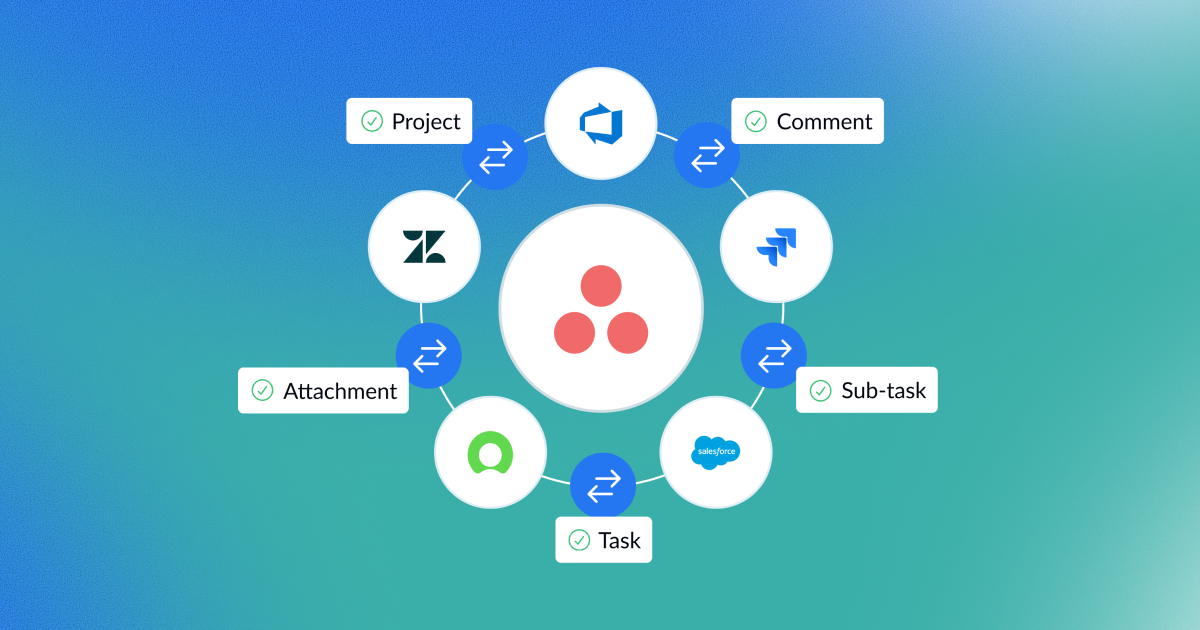
When Asana’s Native Integrations Aren’t Enough (Field Guide)
A Unito field guide for Asana customers: where Asana’s native connectors work well, where they hit a ceiling, and when it’s time to extend them.
You can download this guide by submitting the form on the right –>
In this field guide, you’ll discover:
- Where Asana’s native integrations genuinely shine, and the four jobs they’re built for.
- The four places Asana teams hit a ceiling: trigger-vs-sync, lost collaboration context, flattened work structure, and enterprise realities.
- Six Asana-paired workflows real teams run to keep their whole stack in lockstep.
- A five-point checklist to tell whether you’ve outgrown native integrations.
Your teams don’t all live in Asana, and that’s the problem
Asana is where your work happens. Account plans, campaigns, product roadmaps, delivery projects, cross-functional launches: they all live in Asana for the teams who use it day to day.
But not all work lives in Asana. Your developers are in Jira. Sales is in Salesforce. Support is in ServiceNow. The PMO rolls everything up in Smartsheet. Each of those tools is the source of truth for the team that owns it, and not always visible to the teams working in the other tools.
Asana knows this, which is why it ships native integrations for the most common cross-tool pairings. They cover the most common handoffs well. The Asana-Jira integration gives a marketing manager line of sight into an engineering ticket. The Asana-Salesforce integration can kick off a delivery project the moment a deal closes. If those are the jobs you need done, Asana’s native integrations are often the right answer.
But there’s a ceiling. Asana’s native integrations are built to open a window between Asana and another tool, not to make them work as one. The moment two teams need to work on the same item from different sides, and both need it to stay in sync, linking isn’t enough.
This field guide walks through the four places Asana teams hit that ceiling, the workflows where it shows up, and what it looks like when Asana is extended with Unito.
What’s inside
Where native integrations work well. They’re the right answer for single-team awareness, linking instead of syncing, low-volume one-way automations, and prototyping a first integration. The guide spells out exactly when to reach for them.
The four cracks. Where the ceiling shows up: workflow triggers that fire once in one direction instead of a true two-way sync; the comments, attachments, and context that get left behind; the parent-child structure of work that flattens in transit; and the enterprise realities like Jira Cloud-only support, one issue type per project, and the quiet quarterly cost of maintaining each connector.
How teams extend Asana with Unito. Six of the most common Asana-paired workflows our customers run, from Sales-to-Delivery and Product-to-Engineering to IT, portfolio reporting, Azure DevOps, and Marketing-to-Sales.
A readiness checklist. Five plain-language signals that tell you whether you’ve outgrown native integrations, and what “Asana-and-more” looks like when you have.
This guide is for
- Asana Ops, RevOps, IT, and PMO leaders evaluating cross-tool integration options.
- Asana power users who’ve felt the pain of broken handoffs with teams in Jira, Salesforce, or ServiceNow.
- Anyone weighing whether to extend Asana beyond what its native integrations can do.
Fill out the form to your right to download the guide.
Ready to see it in your stack?
Unito is built for the moment you outgrow native integrations: live, two-way sync between Asana and 60+ other tools. Every field, native and custom, not a limited subset. Full collaboration layer. Preserved work structure. No-code setup. No action limits. Works on every Jira Cloud deployment, plus Jira Data Center and Server where Asana doesn’t.
Book a demo and we’ll walk through exactly how Unito would sync the tools your team uses today.
Trusted by Fortune 500 organizations and global brands.